
How to Measure Light Levels Correctly in a Poultry House
Updated: Oct 9
Why Measuring Light levels Matters
Light intensity plays a critical role in modern poultry production. It influences bird behaviour, feed intake, growth, welfare, and overall flock performance. However, simply installing a lighting system does not guarantee that the birds are receiving the correct amount of light.
The only way to verify the actual light level is to measure it correctly using a lux meter.
Unfortunately, many measurements are taken incorrectly, leading to misleading results and unnecessary adjustments to the lighting system. This guide explains how to accurately measure lux in a poultry house and highlights the most common mistakes to avoid.
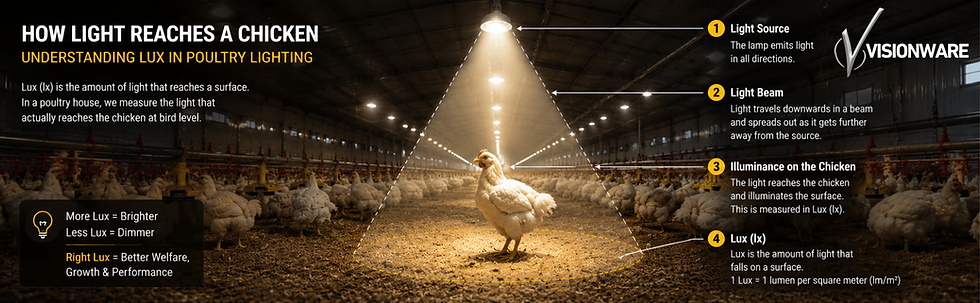
What is Lux?
Lux (lx) is the amount of light that reaches a surface. Unlike lumens, which describe the total light output of a lamp, lux tells you how much usable light is actually available where the birds are located. For poultry producers, the important measurement is the light reaching the birds, not the light emitted by the fixture.
Use the Suitable Lux Meter
For reliable measurements, use a good-quality, calibrated lux meter suitable for measuring LED lighting. The meter should have a spectral response that closely follows the CIE photopic response and a cosine-corrected sensor. Low-quality meters may respond differently to different light spectra, resulting in inconsistent readings between warm-white, natural-white, cool-white or coloured lighting systems.
When selecting a lux meter:
Use a calibrated instrument from a reputable manufacturer.
Look for a cosine-corrected diffuser.
Avoid smartphone applications for lighting verification.
Follow the manufacturer’s calibration recommendations.
Where Should Lux Be Measured?
Lux should be measured where the birds experience the light. Measurements should include positions underneath the light fittings, between fittings, near the walls and in the corners of the house. Avoid relying only on readings taken directly beneath a lamp, as these normally represent the brightest areas.
The sensor should typically be placed:
At bird head height.
On the surface or slightly above it.
Pointing straight upward toward the ceiling.
Away from shadows created by your body.
Never hold the meter close to the light fitting or against the ceiling, as this measures the fixture rather than the lighting conditions experienced by the birds.
Measure Across the Entire Poultry House
Measure along both side rows.
Measure down the centre rows.
Include areas between fixtures.
Include corners.
Include the beginning, middle, and end of the house.
Taking multiple measurements provides a true picture of lighting uniformity. For large poultry houses, measurements every 3–5 metres along each row generally provide good coverage. More measurement points will produce a more accurate assessment.

Record the Average Lux
Lighting systems are designed around the average illuminance, not the highest reading.
For example:
Point 1: 23 lux
Point 2: 20 lux
Point 3: 21 lux
Point 4: 19 lux
Point 5: 22 lux
Average lux:
(23 + 20 + 21 + 19 + 22) ÷ 5 = 21 lux
Looking only at the brightest or darkest point can give a misleading impression of the overall lighting performance.
Check Lighting Uniformity
Uniform lighting is just as important as the average lux level. Large differences in light intensity encourage birds to gather in brighter areas while avoiding darker sections of the house. Good lighting systems aim to minimise these variations so that birds experience consistent conditions throughout the building. If some readings are significantly higher or lower than others, adjustments to fixture spacing, mounting height, or dimming levels may be required.
Uniformity = Minimum lux ÷ Average lux × 100
19 lux ÷ 21 lux × 100 = 90.5% uniformity.

Common Mistakes to Avoid
Many inaccurate lighting assessments result from simple measurement errors.
Avoid these common mistakes:
Measuring directly underneath a light fitting only.
Taking only one reading.
Holding the sensor at chest height.
Blocking the sensor with your body.
Tilting the sensor instead of keeping it level.
Using a smartphone lux application.
Using an uncalibrated or low-quality meter.
Measuring immediately after switching the lights on before they have stabilised.
Ignoring areas between fixtures and near the walls.
Comparing measurements taken with different meter types.

Best Practice Measurement Procedure
For reliable and repeatable results:
Allow the lighting system to stabilise before taking measurements.
Place the lux meter at bird height.
Keep the sensor horizontal and facing upward.
Measure throughout the poultry house using a regular grid.
Record every reading.
Calculate the average lux level.
Check for areas with unusually high or low readings.
Repeat measurements after any lighting adjustments.

Final Thoughts
Accurate lux measurements are essential for verifying that a poultry lighting system performs as intended. Using the correct instrument, measuring at the correct height, and collecting readings across the entire house will provide a far more reliable assessment than a single measurement beneath a lamp. Consistent measurement methods also make it easier to compare houses, evaluate lighting upgrades, and maintain the desired lighting conditions throughout each production cycle.
