
How a Day/Night Switch Works, and How to Choose One That Lasts
Updated: 20 hours ago
Every night, thousands of street lights, security lights and signs across South Africa switch on by themselves. The small device doing that job is the day/night switch, also called a photoelectric control unit, or PECU. It's cheap and easy to ignore, until it fails and the lights stay on all day or don't come on at all.
How it works
A day/night switch has two parts: a light sensor and an electrical switch (a relay). The sensor watches the daylight. When it gets dark enough, the relay closes and the light comes on. When the sun rises, the relay opens and the light goes off. Most units switch on at about 60 lux, with some tolerance, so lights come on at dusk rather than in full darkness.

Where they're used
Street lights, security and flood lights, advertising boards, and other loads such as water pumps and solar geysers.

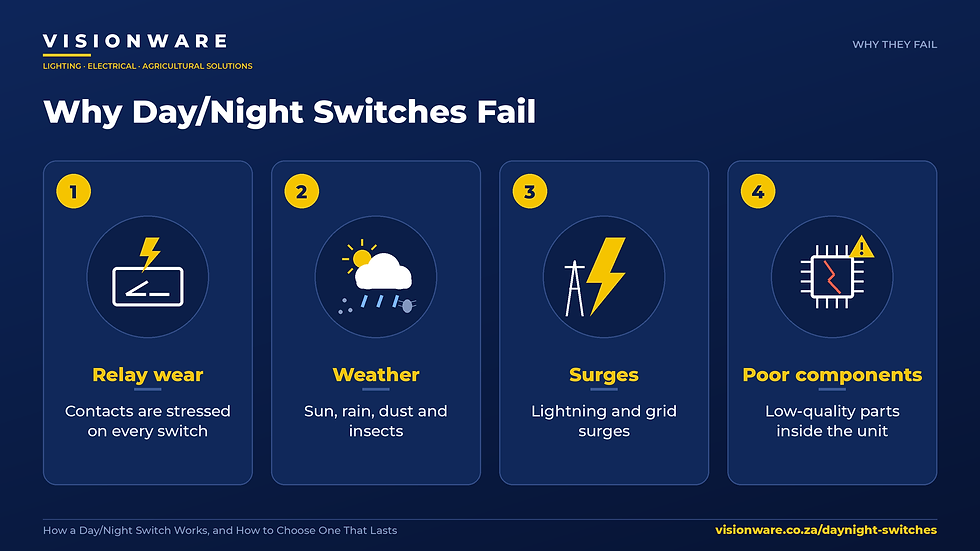
Why they fail
Relay wear. Every switch-on and switch-off puts stress on the relay contacts. A relay that closes at the wrong moment in the AC cycle wears out sooner.
Weather. Sun, rain, dust and insects get into poorly sealed units and cheap plastics go brittle.
Surges. Outdoor lighting takes a beating from lightning and grid surges.
Poor components. Cheap units save money on the parts that decide how long they last.
What to look for
Synchronised zero-volt switching. The relay closes when the current passes near zero volts. This reduces the stress on the contacts every time the light switches, which helps the relay last. It's a feature of our V-Light 25 A models.
Weatherproof housing. Look for water and dust protection, UV-resistant plastic and a flame-retardant housing.
Surge-resistant components for outdoor installations.
Compliance with SANS 1777, the South African standard for photoelectric control units.
The right model for the job. Choose the model that suits your load, such as the 10 A and 25 A versions, the NEMA plug-in version, or the 25 A version with a fly lead.

Why we build ours in South Africa
V-Light day/night switches are manufactured by Visionware in South Africa, and more than 4 million units have been made for the local market. Building locally means we control quality and consistency, and it keeps skilled jobs here.
Need day/night switches for a project or for resale? Visit our day/night switch range or email office@visionware-sa.biz.